
- Google Maps now predicts EV battery levels using real-time AI models.
- Smart charging stop suggestions help drivers plan long EV trips confidently.
- Android Auto integration gives EV drivers in-car access to all new features.
Google Maps has always been the go-to navigation app for millions of drivers around the world. Now, Google is making it even more useful for electric vehicle owners by adding AI-powered battery predictions, smart charging stop recommendations, and smarter trip planning directly inside the app. This is a big deal for anyone who has ever felt the stress of watching their EV battery drop on a long drive with no charging station nearby.
The update is rolling out in the United States for over 350 EV models from more than 15 brands, and it works through Android Auto. Whether you drive a popular sedan or a newer SUV, Google Maps is now capable of giving you a detailed breakdown of your battery levels before you even begin your journey. The feature is designed to reduce range anxiety and make EV ownership far more practical for everyday drivers.

Google Maps AI Battery Predictions Explained
How the AI Model Works
The core of this update is an AI model that Google built to understand how different electric vehicles consume battery power. It does not give you a generic estimate. Instead, it factors in the specific battery size and weight of your vehicle, combined with live data on traffic conditions, road elevation, and the current weather. This combination of inputs allows Google Maps to calculate a much more accurate picture of how much battery you will have left at different points along your route.
Previously, EV drivers had to rely on the car’s own built-in estimates, which are often too optimistic and fail to account for real-world variables like a steep climb or a slow traffic crawl. With this update, Google Maps AI does that thinking for you, in real time, as you drive.
What Information Does It Use
The Google Maps AI model pulls together multiple data points to generate battery predictions. It looks at your vehicle’s battery capacity and weight class, then combines that with live traffic conditions, the elevation of the road ahead, and current weather conditions like temperature and wind. Together, these inputs give the app a realistic model of how your specific EV will perform on your specific route on that specific day.

Smart Charging Stop Recommendations
Setting Up Your EV Profile
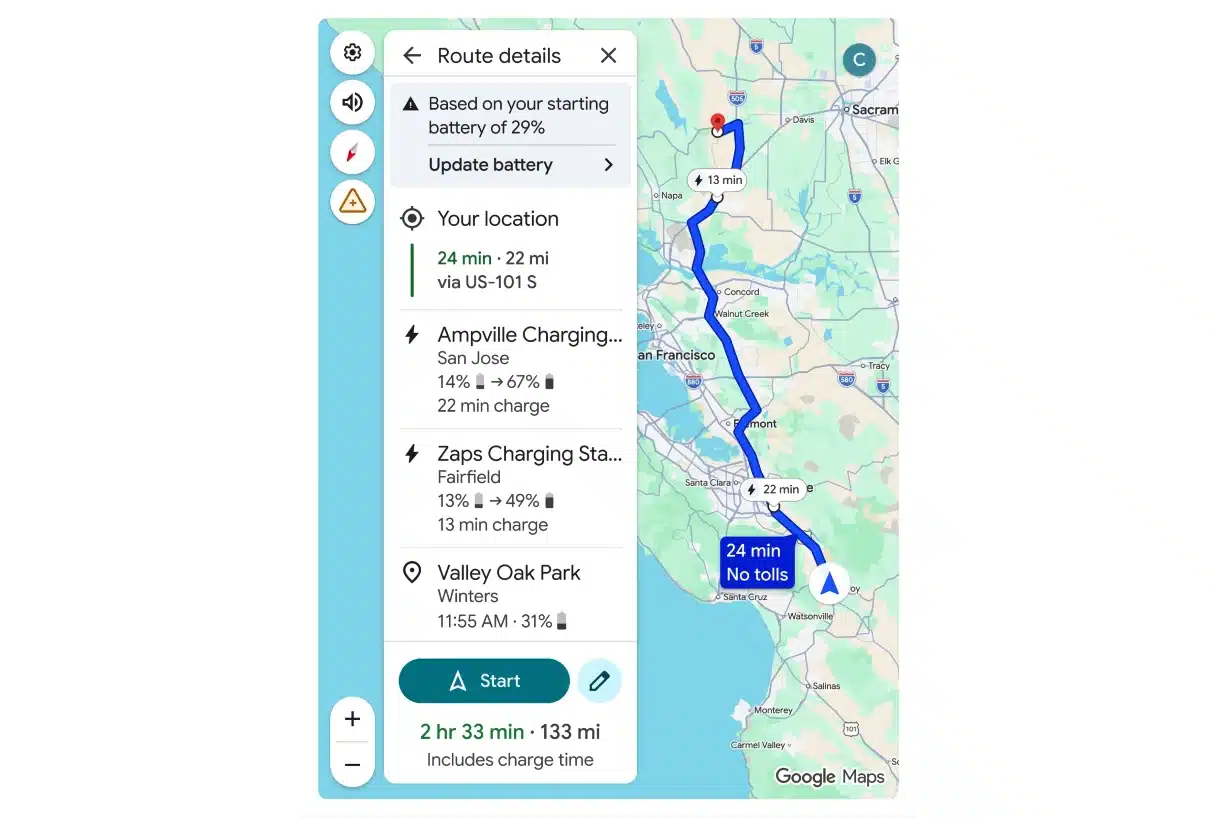
Once you set up your EV profile inside Google Maps, you enter your current battery level and your destination. The app then calculates the entire route with charging needs already factored in. It suggests where to stop for charging along the way, shows what your battery level will be on arrival, and adjusts your estimated time of arrival based on how long each charging stop is expected to take.
This removes the need to switch between multiple apps while planning a trip. Earlier, many EV owners had to use a separate app just to find charging stations and then manually factor that into their navigation. Google Maps now handles all of this in one place.
Real-Time Updates While Driving
The charging suggestions update dynamically as you drive. If you take a detour, hit unexpected traffic, or face a sudden change in weather, the app recalculates your charging needs on the fly. This real-time adaptability is what makes this feature stand apart from older, static EV routing tools available today.
How Android Auto Makes It Better
In-Car Navigation Without Touching Your Phone
The entire experience is built around Android Auto, which means you can access everything directly from your car’s display screen without picking up your phone. After setting up your EV profile, you start navigation from the car interface as usual. The route automatically includes battery consumption estimates, and charging stop recommendations appear on screen in real time.
This is a practical and safe way to use the feature. Drivers do not need to manually search for charging stations while on the road. Android Auto brings everything to the dashboard in a clean, easy-to-read format that works well even at highway speeds.
Who Benefits the Most
For people who use Android Auto daily, this update turns Google Maps into a genuinely intelligent co-pilot for EV travel. Long-distance commuters, highway travellers, and anyone driving in unfamiliar areas will find this feature especially useful. It takes the guesswork out of one of the most stressful parts of owning an electric vehicle.
Supported EV Models and Brands
Which Vehicles Are Covered
The AI-powered battery prediction feature in Google Maps currently supports over 350 electric vehicles across more than 15 brands in the United States. Google combines vehicle-specific data, including battery capacity and weight, with live navigation data to deliver consistent predictions across all supported models.
If your car is not on the list today, it is likely to be included in future updates. Google has confirmed that more vehicles and more regions will be added over time as the rollout expands.
Expansion Plans
The feature is live in the United States right now for hundreds of Android Auto compatible EVs. Google has not confirmed a timeline for other markets yet, but given how rapidly the EV segment is growing globally, an international expansion in the coming months would not be surprising.
Why This Matters for EV Owners
Solving Range Anxiety
Range anxiety is one of the biggest reasons people hesitate before buying an electric vehicle. The fear of running out of charge on a long drive, far from a charging station, is very real. Google Maps is tackling this directly by giving EV drivers accurate information before they need it.
By using AI to model battery behaviour for each specific vehicle, the app moves well beyond the guesswork that used to define EV navigation. You no longer have to hope your car’s estimate is accurate or worry about finding a charging station at the last minute.
Fewer Apps, More Convenience
One of the biggest practical benefits here is consolidation. Google Maps now handles trip planning, charging stop suggestions, real-time battery estimates, and ETA adjustments all in a single app. That means fewer distractions, less switching between screens, and a much smoother experience overall for EV drivers.
Google Maps is no longer just a navigation tool. It is becoming a smart travel companion that understands your vehicle, reads real-world conditions, and helps you make smarter decisions on the road. For EV owners using Android Auto, this AI-powered battery prediction and smart charging update is one of the most meaningful improvements Google has delivered in a long time. As electric vehicles continue to grow in popularity worldwide, features like these in Google Maps will play a major role in making EV ownership easier and more practical for everyone.
FAQ
What is the Google Maps AI battery prediction feature?
It is a new AI-powered feature that estimates your EV’s battery consumption based on your vehicle type, traffic, road elevation, and weather. It suggests charging stops and updates your ETA in real time.
Which EVs support the new Google Maps AI features?
The feature supports over 350 EV models from more than 15 brands in the United States, available through Android Auto.
Does Google Maps show charging stops automatically for EVs?
Yes. Once you enter your battery level and destination, Google Maps suggests charging stops along your route, estimates battery on arrival, and updates your ETA based on charging time.
Is this Google Maps EV feature available in India?
Currently, the feature is rolling out in the United States only. Google has indicated plans to expand to more regions in future updates.
